You can have the best beans, the cleanest water, and a solid brewing method — but if your grinder isn’t performing properly, your coffee will always fall short.
That’s because grinding is not just a step in the process — it’s the foundation of your entire cup.
A poor grinder can ruin even the most expensive coffee. It can make your espresso taste sour, your French press muddy, and your pour-over unbalanced.
In this article, we’ll go through a complete checklist to help you identify whether your grinder is the real problem — and what to do about it.
This guide is especially useful for home brewers trying to improve their results without wasting time or money on trial and error.
Why Grinding Matters More Than You Think
Grinding coffee is more than just breaking beans into smaller pieces. The size and consistency of your grind affect how water extracts flavor from the grounds.
If the grind is too fine, your coffee will over-extract and taste bitter. Too coarse, and you’ll get sour or weak coffee.
But it’s not just about grind size — it’s about uniformity. You want all the particles to be roughly the same size, so they extract evenly.
When your grinder creates both dust and boulders in the same batch, it leads to an imbalanced cup — no matter how good your other gear is.
This is where most low-quality or worn-out grinders fail.
1. Your Coffee Tastes Inconsistent Day to Day
If one day your coffee tastes perfect and the next day it’s off — even when you use the same beans and method — your grinder might be at fault. Inconsistent flavor is a common symptom of uneven grinding.
Why This Happens
- The grinder’s burrs may be dull or misaligned
- Cheap grinders often shift during use, changing the grind size
- Blade grinders are inherently inconsistent
How to Test It
- Brew the same method for 3 days in a row using the same beans
- Don’t change any variables — dose, water, brew time
- If flavor still changes dramatically, suspect the grinder
Inconsistent results are one of the biggest red flags for grinder problems.
2. You See Large and Small Particles in the Same Batch
A good grind looks uniform. If you notice big chunks of bean mixed with powder, you’re dealing with poor particle distribution. This leads to uneven extraction — with fines over-extracting and boulders under-extracting — resulting in sour, bitter, or muddled cups.
Why This Matters
Uneven grind sizes cause part of your coffee to taste overdone and part to taste underdeveloped. It’s a balance killer.
How to Check
- Place a pinch of ground coffee on a white sheet of paper
- Gently spread it out and examine the particle sizes
- If the grounds vary wildly, your grinder is not doing its job
This issue is especially common with blade grinders and entry-level burr models.
3. Your Grinder Jams or Slows Down During Use
If your grinder struggles to process beans or stops mid-grind, it’s likely either poorly designed or not being maintained properly.
Possible Causes
- Old or oily beans clogging the burrs
- Dull burrs that can’t slice efficiently
- Motor strain in cheap grinders
- Internal parts misaligned over time
What You Can Do
- Clean your grinder regularly — at least once a week for daily users
- Use dry, freshly roasted beans — not dark, oily ones
- Avoid overloading the hopper with too many beans at once
- If the problem persists, it may be time for a replacement
Grinders should run smoothly. If you have to “fight” your grinder to get a dose, something’s wrong.
4. You Can’t Dial In Your Espresso or Pour-Over
You adjust the grind finer — nothing improves. You adjust coarser — things get worse. If you’re stuck in a loop of adjusting grind settings and still getting poor results, your grinder may lack precision.
Symptoms of a Bad Adjustment System
- Too few grind settings — wide jumps between steps
- Settings slip during grinding
- Numbers don’t match actual output
- Inability to hit fine or coarse enough for your brew method
Best Practice
- Look for a grinder with micrometric or stepless adjustment for espresso
- For pour-over or French press, 30+ steps allow for fine-tuning
- Avoid grinders labeled “universal” with vague controls
Being able to control your grind precisely is essential — especially with espresso and specialty methods.
5. Your Coffee Is Always Bitter or Always Sour
If your brews consistently lean bitter or sour — and you’ve already ruled out issues with water, temperature, or beans — your grinder may be misbehaving.
What This Means
- Always bitter: Possibly over-extraction due to uneven fines
- Always sour: Likely under-extraction from coarse or inconsistent grinds
Troubleshooting
- Try a middle grind and pull a shot or make a cup
- Use a scale and timer to eliminate other variables
- If the result still swings hard in one direction, check your grind quality
Many home brewers blame beans when it’s really the grinder ruining the balance.
6. You’re Still Using a Blade Grinder
Blade grinders don’t grind — they chop. That results in a mixture of powder and chunks with no control over particle size. They’re cheap, but the damage they do to coffee is real.
Why They Don’t Work
- Inconsistent grind size
- Heat from the blade can scorch coffee
- No way to adjust for different brewing methods
What to Do Instead
- Upgrade to a burr grinder, even an entry-level model
- Manual burr grinders are affordable and far superior
- Use fresh beans and proper technique for best results
If you care about coffee flavor, ditching the blade grinder is the fastest way to improve.
7. You Can’t Grind Fine Enough for Espresso
If you own an espresso machine but your grinder can’t deliver a true espresso grind, you’ll never get a proper shot. Many burr grinders labeled “espresso-capable” still fail to hit the fine end of the spectrum.
Signs to Watch For
- Shots run too fast, even on the finest setting
- Crema is thin or absent
- Taste is sharp, sour, or underwhelming
- Grinder produces clumps or static
What You Need
- Look for espresso-specific grinders or high-quality manual options
- Check user reviews for grind range before buying
- If you’re on a budget, options like the 1Zpresso JX-Pro or Baratza Encore ESP work well
Espresso is the most demanding brew method — your grinder must be up to the task.
8. Static and Retention Are Out of Control
Some grinders produce a mess every time you use them. Grounds stick to the chute, fly all over the counter, or leave old coffee behind that ends up in your next cup.
Causes
- Static buildup from fast-spinning burrs or cheap plastics
- Poorly designed chutes that clog easily
- Retention chambers that don’t fully empty
Solutions
- Tap or knock the grinder gently after use
- Use a bellows tool to push out remaining grounds
- Consider a grinder with low retention and anti-static tech
- Spray beans lightly with water before grinding (Rao’s RDT method)
Messy grinders don’t just waste coffee — they ruin consistency.
How to Fix or Replace a Bad Grinder
If your grinder is showing multiple signs of failure, it may be time to upgrade. But before you replace it, consider these steps:
Maintenance Checklist
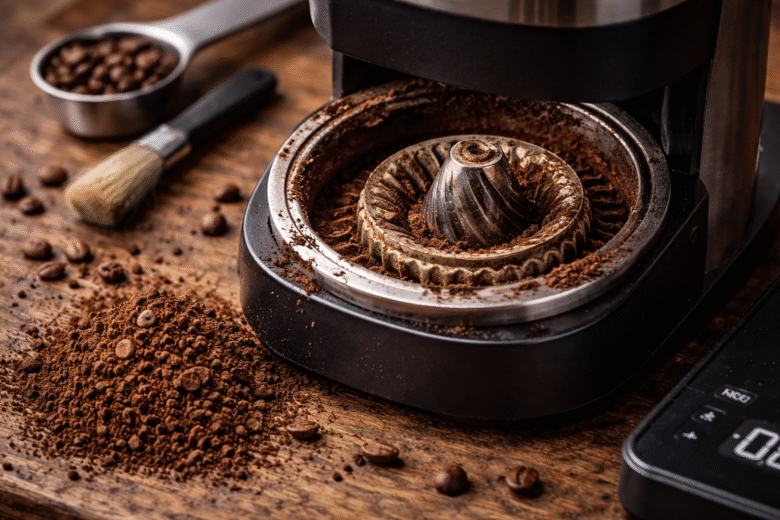
- Deep clean your grinder — including burrs and chute
- Inspect burrs for dullness or misalignment
- Recalibrate settings (many grinders allow re-zeroing)
- Use high-quality, dry beans
- Avoid overfilling or overworking the motor
Sometimes a simple clean-up and recalibration restore a grinder to working order.
Signs It’s Time to Replace
- Inability to grind fine or coarse enough
- Visible burr damage
- Motor stalls or slows during grinding
- Excessive retention and static
- No consistency in results despite cleaning
If these issues persist, investing in a new grinder is often the best long-term solution.