
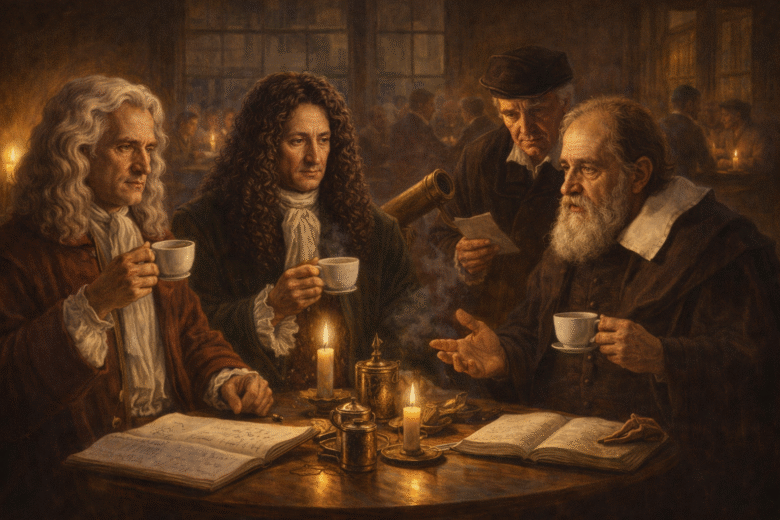
The 1600s marked a turning point in human understanding. Known as the Scientific Revolution, this period gave rise to groundbreaking ideas that changed the way we see the world.
From physics to astronomy, and from medicine to mathematics, a new wave of thinkers was redefining knowledge.
But behind many of these discoveries was an unlikely partner: coffee.
Yes — that steaming cup of black liquid became a quiet co-pilot in the minds of great scientists. Let’s explore how this once-controversial beverage helped fuel one of the most intellectually fertile centuries in human history.
From Taverns to Coffeehouses: A New Kind of Thinking Space
Before the arrival of coffee in Europe, most social gatherings happened in taverns.
People drank alcohol, often from early morning. While wine and ale were common, they dulled the senses rather than sharpening them.
With coffee came a cultural shift.
People began meeting in coffeehouses — sober, alert, and talkative. These were not bars. They were “penny universities,” where for the price of a cup of coffee, one could engage in intelligent discussion.
Ideas spread. Minds met. Debates unfolded.
In London, Oxford, and Paris, coffeehouses became unofficial laboratories of thought.
Coffee and Isaac Newton’s Focus
Isaac Newton is often regarded as the father of modern science. He formulated the laws of motion and gravity, among other things.
While his genius is undeniable, his habits also played a role in his productivity.
Newton frequently visited a coffeehouse near Cambridge University.
It was here that scholars discussed astronomy, mathematics, and theology — often with a cup of coffee in hand.
Newton was known to isolate himself for days, working tirelessly. Coffee is believed to have supported these long, focused sessions.
Stimulants like caffeine helped maintain concentration during the kind of deep thinking that Newton’s theories demanded.
The Role of Coffee in the Birth of Calculus
Calculus — one of the greatest mathematical tools ever developed — emerged in the 17th century. Newton and German mathematician Gottfried Wilhelm Leibniz both developed it independently.
Their work required long hours of abstraction and focus.
At the time, coffee was still a novelty, but was gaining popularity fast.
Leibniz, who corresponded with scientists across Europe, often mentioned his enjoyment of coffee. It kept his mind active during dense calculations and philosophical writing.
Many scholars credit the coffee culture of European intellectual circles with helping fuel the long mental marathons required for such innovation.
Galileo, Telescopes, and Caffeinated Nights
Galileo Galilei, the father of modern astronomy, made historic observations of the heavens in the early 1600s.
He discovered Jupiter’s moons, detailed the phases of Venus, and supported the Copernican model of a sun-centered universe.
His work required hours of nighttime observation.
Galileo didn’t have access to modern coffee as we know it — but he did consume caffeinated herbal infusions, and was known for working late into the night.
Shortly after his time, however, coffee spread across Italy, and the next generation of astronomers adopted the drink during their night watches.
By the end of the century, coffee was a staple among late-night thinkers.
Coffee and the Scientific Societies
The Royal Society, founded in 1660 in London, became a hub for scientific exchange.
Many of its members met at coffeehouses like The Grecian or Jonathan’s.
It wasn’t just a social affair.
Coffeehouses functioned as proto-scientific forums, where scientists presented papers, argued methods, and tested hypotheses — all over cups of coffee.
The environment was uniquely suited for intellectual engagement: well-lit, affordable, and alcohol-free.
In this space, caffeine didn’t just keep scientists awake — it kept science alive.
Descartes, Mind, and Stimulation
René Descartes, the French philosopher and mathematician, is famous for the phrase, “I think, therefore I am.”
He spent most of his days thinking — often in solitude, fueled by warm drinks and focused intention.
Though Descartes preferred hot chocolate, the rise of coffee in French salons overlapped with his later life and writings.
His rationalist philosophy found resonance in coffeehouse culture, where reason and logic were prized over superstition and tradition.
The clarity that coffee brought mirrored Descartes’ vision of the world as understandable through human logic.
Coffee and Medical Innovation
In the 1600s, medicine was still heavily influenced by superstition.
But as scientific thinking emerged, doctors began experimenting, observing, and documenting with more rigor.
Coffee, seen initially as a medicinal drink, was studied by early physicians.
Some believed it could balance the body’s humors; others saw it as a stimulant for the mind.
In 1681, a London physician named Dr. William Harvey (not to be confused with the earlier William Harvey who discovered blood circulation) wrote about coffee’s stimulating effects on the brain.
His writings helped shift the perception of coffee from exotic luxury to useful intellectual tool.
Coffee as Catalyst for Publishing
With more scientists and thinkers staying awake and writing through the night, the volume of printed work exploded.
Coffeehouses often doubled as publishing hubs.
Writers brought manuscripts to cafés. Printers visited to collect ideas. Journalists picked up stories.
The first scientific journals, like Philosophical Transactions, circulated in these caffeinated spaces.
The spread of coffee directly contributed to the spread of knowledge.
Coffee vs. Alcohol: A Healthier Alternative for the Mind
One reason coffee gained so much popularity among scientists was simple: it was a better alternative to alcohol.
Unlike wine or beer, which were the safest liquids to drink due to water contamination, coffee was boiled — making it safe, and non-alcoholic.
This allowed thinkers to remain sharp during discussion and study.
It’s hard to imagine Newton doing calculus after three mugs of ale.
Coffee offered clarity and focus — essential ingredients for discovery.
The Global Trade That Fueled Global Ideas
As coffee spread from Arabia to Europe via the port cities of Venice, Amsterdam, and London, so did ideas.
Coffeehouses became centers of global trade news, scientific gossip, and intellectual exchange.
People from different social classes, professions, and beliefs gathered over coffee.
This democratization of discussion helped ideas travel faster and break traditional boundaries.
The 1600s weren’t just about discoveries. They were about sharing discoveries.
And coffee was the glue holding those conversations together.
Women, Science, and Coffee
Though early coffeehouses were often male-dominated, women also found their place in the intellectual world of the 1600s.
In French salons, many hosted by aristocratic women, coffee was served as part of philosophical gatherings.
These spaces offered a more inclusive alternative to traditional academic institutions, and helped nurture female voices in early science and literature.
Coffee, again, acted as a social equalizer — allowing more minds to engage in critical thought.
Was Coffee the Fuel or the Fire?
It’s tempting to see coffee as a magical drink that caused the Scientific Revolution.
That’s not entirely accurate.
The revolution was already brewing, but coffee accelerated the process.
It replaced alcohol in academic settings. It extended the working hours of geniuses. It brought people together in fresh, dynamic ways.
And it gave thinkers the stamina they needed to question the universe.
The Rise of the Scientific Method and Mental Stamina
The scientific method — observe, hypothesize, experiment, conclude — demands patience.
The caffeine in coffee helped thinkers stay focused through lengthy experiments and repetitive observations.
Whether examining a pendulum’s swing or observing a star’s movement, scientists needed clarity.
Coffee helped them maintain it.
A Legacy Still Brewing
Today, we often grab a coffee without thinking.
But in every cup lies a history of ideas.
Newton, Leibniz, Galileo — all men who reshaped our world — likely sipped a bitter brew as they changed the course of humanity.
The next time you drink coffee during work or study, remember: you’re part of a long tradition of thinkers who did the same.
Final Sip: What We Owe to the Brew
The 1600s gave us gravity, the telescope, blood circulation theory, calculus, and so much more.
And quietly, in the background, was coffee.
It’s not just a drink. It’s been a companion to brilliance, a stimulant for discovery, and a catalyst for conversation.
Perhaps the real revolution didn’t just happen in the stars or in the lab — it happened over a cup of coffee.