If your coffee at home still doesn’t taste quite right — even with good beans and a quality grinder — there’s one affordable tool that could change everything: a coffee scale.
Brewing without measuring your coffee and water is like baking without measuring flour. It’s possible, but the results are inconsistent. A coffee scale helps you fix that by removing guesswork from your routine.
This guide will show you how to choose the right coffee scale based on your brewing style, budget, and experience level. You’ll also learn how to use one to make every cup more consistent and flavorful.
Why You Need a Coffee Scale
You might wonder if a scale is really necessary. After all, can’t you just scoop your coffee?
The short answer is no — not if you want reliable results.
The problem with scooping is that coffee density changes depending on the roast, grind size, and even humidity. One tablespoon of beans today may weigh more or less tomorrow. That leads to under- or over-extraction, causing your coffee to taste sour, bitter, or just off.
A coffee scale solves this problem by giving you precise control over your brew ratio — the relationship between coffee and water.
With a scale, you’ll be able to repeat your favorite recipes and fix mistakes faster. It’s one of the easiest and cheapest upgrades for serious home brewers.
What Makes a Coffee Scale “Good”?
Not all scales are created equal. Here are the most important features to consider when choosing a scale for coffee:
- Accuracy and sensitivity: Must read in grams, ideally down to 0.1g
- Built-in timer: Essential for pour-over or manual brewing
- Speed: Fast response time matters for real-time pouring
- Size and platform: Needs to fit your equipment
- Battery life and type: USB rechargeable is ideal
- Water resistance: Protection from splashes is a big plus
- Durability: Should last under daily use
Let’s look at how these features apply to different brewing methods and user needs.
Matching Your Scale to Your Brewing Style
The best coffee scale for you depends on how you brew your coffee. Let’s match the scale to your routine.
For Pour-Over Fans
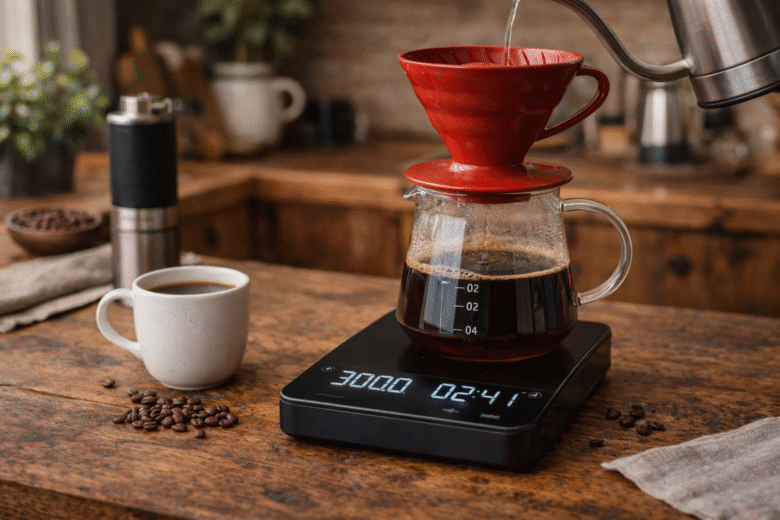
If you brew using a Hario V60, Chemex, or similar device, you need a scale with:
- High precision (0.1g increments)
- Built-in timer
- Fast response time
Pour-over brewing is all about control and timing. A slow or laggy scale makes it hard to pour water evenly. You also want a large enough surface to hold both your dripper and mug or server.
For French Press or AeroPress
You won’t need as much precision for immersion brewers. A standard scale with 1g accuracy is usually enough. A built-in timer helps but isn’t required.
If you make larger batches, consider a scale with a bigger platform and higher capacity — around 2 to 3 kilograms is ideal.
For Espresso
Espresso requires extremely high accuracy. You’ll need a scale with:
- 0.1g or finer precision
- Fast refresh rate
- Compact size to fit on a drip tray
- Water resistance
Specialty espresso scales are often more expensive, but if you want to dial in shots accurately, they’re essential.
For Beginners
If you’re just starting out, look for:
- Simple interface (no app required)
- Reliable accuracy (at least 1g precision)
- Easy-to-read display
- Decent battery life
There’s no need to invest in a premium model right away. A basic scale can make a big difference and help you learn how brewing ratios affect flavor.
Budget Breakdown: What to Expect at Each Price Level
Coffee scales range from $10 to $300. Here’s what you can expect in each bracket:
$10–$20: Entry-Level
- Basic kitchen scales with gram readings
- May lack timer or fast refresh rate
- Fine for French Press and general brewing
- Less durable and slower to update
Recommended for: Beginners and low-maintenance brewing.
$20–$50: Standard Coffee Scales
- Better precision (often 0.1g)
- Built-in timer
- Faster display updates
- USB charging and compact design
Recommended for: Pour-over lovers and anyone who brews daily.
$50–$150: Professional and Espresso Scales
- Ultra-fast response and refresh
- Splash-proof or waterproof designs
- Bluetooth or app integration
- Dual sensors for weight and flow rate
Recommended for: Espresso and advanced brewing control.
You don’t need to spend a fortune, but spending just a bit more than the cheapest options usually gives you much better performance and reliability.
Best Coffee Scales for Home Use (2026)
Here are a few standout options, each ideal for a specific type of user.
1. Hario V60 Drip Scale
- Price: Around $45
- Accuracy: 0.1g
- Timer: Yes
- Pros: Reliable, widely trusted, pairs perfectly with V60
- Cons: Not waterproof, slightly slow refresh rate
Ideal for pour-over brewers who want precision and simplicity.
2. Timemore Black Mirror Basic+
- Price: Around $55
- Accuracy: 0.1g
- Timer: Yes
- Pros: Fast response, minimalist design, USB-C rechargeable
- Cons: Slightly slippery surface
A favorite among home brewers and baristas for its style and function.
3. Greater Goods Digital Scale
- Price: Around $19
- Accuracy: 1g
- Timer: No
- Pros: Cheap, reliable, large platform
- Cons: No advanced features
Best for beginners or French Press users on a tight budget.
4. Acaia Pearl (if you ever upgrade)
- Price: $150+
- Accuracy: 0.1g
- Timer: Yes, plus app features
- Pros: Ultimate control, fast response, rechargeable
- Cons: Expensive
Not required for most users, but sets the gold standard in coffee scales.
How to Use a Coffee Scale for Better Results
Once you have a scale, here’s how to integrate it into your brewing routine for better results.
1. Weigh Your Beans
Always weigh your coffee beans before grinding. Use a consistent brew ratio — for example:
- 1:15 for stronger coffee
- 1:17 for lighter, more balanced flavor
For a 300g cup of coffee, that means 20g of coffee (300 ÷ 15 = 20).
2. Measure Your Water Precisely
Instead of filling your kettle by eye, pour your hot water directly into the brewing vessel and stop when you hit your desired weight.
This removes the guesswork and ensures proper extraction.
3. Use the Timer for Pour Control
During pour-over brewing, use the timer to control your pour speed and saturation. For example:
- Bloom for 30–45 seconds
- Complete brew within 2.5 to 3.5 minutes
Timing helps you develop consistency and troubleshoot your flavor.
4. Record and Repeat
Once you find a combination that tastes great, write it down — coffee weight, water weight, brew time, grind setting, and method.
Next time, repeat exactly and enjoy the same great cup.
Common Mistakes to Avoid
Using a scale seems simple, but there are a few pitfalls that can limit its impact:
- Forgetting to tare (zero) the scale after placing your equipment
- Relying only on volume measurements like ounces or cups
- Using a scale that isn’t level or stable
- Ignoring timer functions on pour-over devices
- Buying a scale without checking max capacity (important for French Press)
Avoid these issues, and your scale will work the way it should — as a consistency tool that improves every cup.
Why a Scale Improves Every Brew Method
No matter how you make your coffee, a scale improves it. Here’s how:
- Drip Machines: Prevents overloading the basket or under-dosing
- French Press: Balances steeping and strength
- AeroPress: Helps with repeatable concentrate recipes
- Cold Brew: Ensures proper ratio and avoids bitterness
- Espresso: Gives precision required for dialing in shots
A $30 scale has more impact on your coffee than upgrading your brewer — and that’s the truth.
Final Thoughts: Precision Without Complexity
You don’t have to be a professional barista to benefit from a coffee scale. It’s one of the most overlooked tools that separates “just okay” coffee from consistently great results.
Choose a scale that fits your budget and brewing style, then use it with purpose. Over time, you’ll start to recognize how small changes in weight and time lead to noticeable differences in flavor.
With a good grinder, good water, and a basic scale, you’re already ahead of 90 percent of home brewers. And the best part? You didn’t have to spend a fortune to get there.

Nathan Scott is a passionate coffee enthusiast with years of experience exploring the world of beans, brews, and barista techniques. From home brewing tips to discovering the perfect roast, he shares practical advice to help coffee lovers elevate their daily cup. When he’s not testing new brewing methods, Nathan is visiting local cafés in search of unique flavors and stories. His goal? To make great coffee simple, enjoyable, and accessible for everyone.