
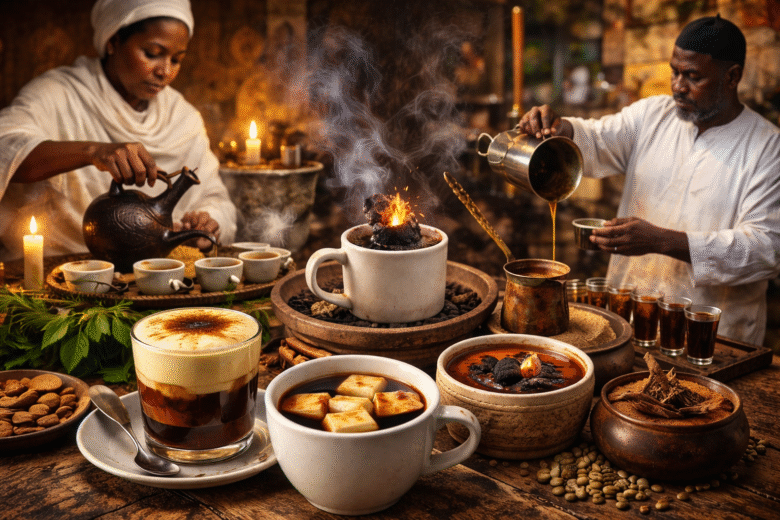
Coffee is deeply woven into cultures across the globe.
While many of us are familiar with espresso machines and French presses, there are brewing methods out there that are centuries old — and still in use.
Some are quirky. Some are spiritual. Others are just plain fascinating.
But all of them are a testament to the diversity and creativity of coffee lovers worldwide.
Here are some of the strangest and most wonderful coffee brewing traditions that are still practiced today.
1. Ethiopian Coffee Ceremony: A Sacred Ritual of Hospitality
In Ethiopia, coffee isn’t just a drink — it’s a ritual.
The bunna maflat (coffee ceremony) is a three-stage brewing process performed almost daily in many households.
It begins with the host roasting fresh green coffee beans in a pan.
The smell fills the room, creating a sensory experience that’s both spiritual and social.
The beans are ground by hand using a mortar and pestle, then brewed in a traditional pot called a jebena.
The ceremony involves three rounds of coffee — abol, tona, and baraka — each one symbolizing deepening friendship and connection.
Participating in the ceremony is considered an honor.
It’s not just about drinking coffee, but about slowing down, engaging, and respecting tradition.
2. Vietnamese Egg Coffee: Dessert or Brew?
Eggs and coffee might not sound like a natural pairing.
But in Vietnam, cà phê trứng is a beloved drink that combines strong robusta coffee with a whipped blend of egg yolk and sweetened condensed milk.
The result?
A thick, creamy, custard-like topping that floats over hot espresso.
It originated in the 1940s in Hanoi, during a milk shortage.
Chefs got creative and turned to eggs as a substitute.
Today, you can find it in both homes and trendy cafes.
It’s sweet, rich, and oddly comforting — more dessert than beverage.
3. Finnish Kaffeost: Coffee with Cheese
Yes, cheese.
In Finland, particularly in the northern regions, it’s common to drop cubes of leipäjuusto (a squeaky cheese made from reindeer or cow’s milk) into a cup of hot black coffee.
The cheese soaks up the brew, becoming soft and warm.
People sip the coffee and nibble the soaked cheese, often with a spoon.
It sounds strange, but locals swear by the comforting contrast.
It’s hearty, warming, and deeply rooted in Finnish tradition.
4. Turkish Sand Coffee: Brewed in Fire and Ash
In Turkey, you might find your coffee brewed in a bed of hot sand.
Yes — real sand.
The cezve (a small metal pot) is buried into the sand, which is heated over a flame.
The even heat distribution allows the coffee to bubble gently and brew slowly.
This method dates back centuries and is still performed in cafés and homes.
The resulting drink is thick, strong, and unfiltered — often served with a glass of water and Turkish delight.
Watching it brew is half the experience.
It feels like a mini performance, full of anticipation and tradition.
5. Indonesian Kopi Joss: Coffee with Hot Charcoal
Imagine this: a sizzling chunk of red-hot charcoal dropped directly into your cup of coffee.
That’s kopi joss, a specialty of Yogyakarta, Indonesia.
The coffee is brewed normally, then the charcoal is added before serving.
It hisses, bubbles, and releases a smoky aroma.
Locals believe the charcoal neutralizes the coffee’s acidity and adds healing properties.
Whether or not that’s true, the taste is unique — smoky, bold, and surprisingly smooth.
It’s an experience that stirs all five senses.
6. Saudi Arabian Qahwa: Coffee Infused with Cardamom and Cloves
In Saudi Arabia, coffee isn’t just about the beans.
Qahwa is brewed with green coffee beans, lightly roasted, and spiced with cardamom, cloves, saffron, and even rose water.
The result is a light-colored, spicy coffee served in small handleless cups.
It’s often paired with dates and shared in social and ceremonial gatherings.
Serving qahwa is a sign of respect and generosity.
In fact, refusing coffee in this context can be seen as offensive.
It’s less about caffeine and more about culture.
7. Swedish Kokkaffe: Boiling Grounds Over an Open Flame
Deep in Sweden’s forests, campers and outdoor lovers often prepare kokkaffe.
The process is simple, rustic, and deeply traditional.
You boil water over an open fire, then toss in coarse coffee grounds.
After a few minutes, cold water is added to settle the grounds at the bottom.
It’s bold, smoky, and unfiltered — perfect for chilly mornings in nature.
Many Swedes swear it’s the best way to truly taste the coffee.
No fancy gadgets, just fire, a kettle, and good company.
8. Bedouin Coffee: The Desert’s Bitter Brew
Among Bedouin tribes in the Middle East, coffee is a symbol of hospitality and strength.
Qahwa Arabiya is made with lightly roasted beans, often spiced with cardamom, and boiled multiple times in a long-spouted pot.
It’s served in tiny cups — and always in odd numbers (1, 3, or 5).
The guest must shake the cup slightly after finishing to indicate they don’t want more.
This tradition has deep meaning.
It signals trust, honor, and even peace between tribes.
9. Italian Moka Pot: A Pressure Classic with a Twist
While the Moka pot is widely known, Italians have their own quirks.
Some add lemon peel to the grounds or a touch of salt to reduce bitterness.
In Naples, caffè sospeso (suspended coffee) is a tradition where someone buys two coffees but drinks only one.
The second is left for a stranger who may not afford it.
It’s a mix of technique and generosity.
Coffee, in this case, becomes a social act.
10. Ethiopian Spiced Coffee: With Ginger, Cinnamon, and Cloves
In some Ethiopian regions, coffee isn’t just roasted — it’s infused.
Ginger, cinnamon, cloves, and even black pepper are added during the brewing process.
This creates a fiery, complex cup that wakes more than just your brain.
It’s often served during holidays or in special ceremonies.
The flavors vary from household to household.
But the goal is always the same: to elevate coffee into something sacred.
11. Mexico’s Café de Olla: Brewed in a Clay Pot
Café de olla is made in traditional clay pots.
It’s sweetened with piloncillo (unrefined cane sugar) and flavored with cinnamon sticks.
This rustic coffee is earthy, rich, and comforting.
It’s served especially in rural areas or during Dia de los Muertos.
The clay pot gives it a distinct flavor that no metal can replicate.
It’s coffee with soul.
12. Senegal’s Café Touba: Coffee with a Spiritual Kick
In Senegal, café Touba is spiced with Guinea pepper (known locally as djar).
The brew originated from a Sufi Muslim brotherhood.
It’s more than a drink — it’s a spiritual practice.
The spicy, peppery coffee is said to sharpen the mind and prepare the soul for reflection.
Vendors sell it on street corners, and it’s consumed by both young and old.
The ritual is as important as the flavor.
13. Thai Iced Coffee with Condiments
Thai iced coffee, or oliang, is often brewed with a blend of beans and grains.
But what’s unusual is what goes with it.
Some vendors add sesame seeds, soybeans, or even tamarind.
It’s sweetened with condensed milk and poured over crushed ice.
Sometimes, a sprinkle of salt or a splash of lime juice finishes the cup.
It’s strange, layered, and wildly refreshing.
14. Cuban Coffee with a Sugar Whip
Cuban coffee, or cafecito, is strong espresso whipped with sugar as it brews.
The sugar caramelizes, forming a creamy foam on top.
It’s served in small portions, but packs a punch.
Often shared among friends at “ventanitas” — little windows of neighborhood cafés.
There’s rhythm to the pour and sip.
A community ritual, caffeinated.
Final Thoughts: The World in a Cup
Coffee connects us all — but not in the same way.
While some pour from pods, others stir hot charcoal into their brew.
These weird and wonderful traditions remind us that coffee is more than convenience.
It’s identity. It’s ceremony. It’s history in motion.
Next time you sip your standard cup, think of the cheese cubes in Finland or the spiced brews of Senegal.
There’s a world of weird out there, and it tastes amazing.

Nathan Scott is a passionate coffee enthusiast with years of experience exploring the world of beans, brews, and barista techniques. From home brewing tips to discovering the perfect roast, he shares practical advice to help coffee lovers elevate their daily cup. When he’s not testing new brewing methods, Nathan is visiting local cafés in search of unique flavors and stories. His goal? To make great coffee simple, enjoyable, and accessible for everyone.